




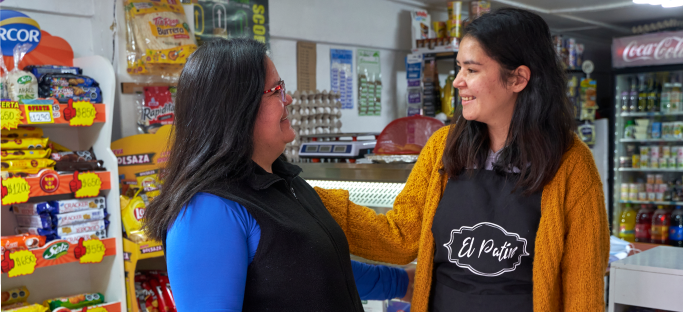
When a person approaches a neighborhood store and finds a wide variety of options for the product they are looking for, the first thing they do is focus on the shelves; as if they are about to capture a photograph. The tendency, in general, is to stop in front of a portfolio of similar products to decide which one to choose.
How to ensure that within that frame or photo they see, there is everything necessary for the sale to be efficient and no one loses?
An ideal model for the traditional channel
When we talk about the “picture of success” we are faced with a concept that has been thought about for many years in the large consumer goods multinationals, from which improvement opportunities can be defined in the traditional channel.
It involves the establishment of execution standards, that is, a series of actions that, carried out efficiently, can enhance the point of sale, thus facilitating the growth and development of a brand or a product category.
It is not only about thinking about what we can visually attribute to that photo, but it also involves different variables that allow us to improve the well-known ways of doing/obtaining better sales and, above all, generating customer satisfaction.
For the storekeeper, for example, it is the ideal combination of timely stock replenishment, display of offers, correct visibility of products in the physical location, among other elements.
Talking about the “picture of success” finally means talking about a “perfect store”; that is, a store that is properly stocked, with all the company’s SKUs possible and in minimum but sufficient quantities.
In the case of a soda brand, for example, the ideal picture of success would be that of a neighborhood kiosk that offers for sale the full variety of products of the mass consumer company or, at least, the majority of them. In practice, this would mean having the main SKUs of the brand in different formats and flavors.
How can data bring us closer to the picture of success?
Today it is possible to execute actions with excellence based on data, so that brands and products have an effective presence at the point of sale. This, thanks to the incorporation of artificial intelligence and machine learning, which provide reliable data to guide both the seller and the storekeeper, and standardize action and optimization processes. In this way, the consumer will not leave the store without buying, nor will they have to go to another one to satisfy their need.
Here are some variables to consider to materialize a positive change in the management of the traditional channel, with the help of the data provided by artificial intelligence:
- Segmentation: identify and understand the customer, the type of store format, its size, the socio-economic level of the area where it is located, the commercial region, among others.
- Visibility: determine how to manage and, consequently, increase the exposure of the brand or category.
- Variety: define which product assortment to work on in each store. Don’t forget their rotation.
- Monitoring: in general, what is not seen is not sold, and what is not there, much less, which is why it is very important to monitor the correct availability of the product on the store shelf.
- Competition: pay special attention to the actions of the competition, to learn from them or, in any case, to counteract them.
Artificial intelligence: a tool that transforms your business
The social context of recent times has led to a boom in neighborhood stores, which are growing, in part, because they provide trust and security to customers. But that is not enough. For the final picture to be successful, all the resources that Artificial Intelligence can provide must be exploited. Without data analysis and proper sales personalization, the path to an optimized traditional channel will be uphill.
Today, this channel is presented as an archaic system, with ways of being and doing that have been left behind. And the storekeeper, for his part, represents a figure who has little or no information about sales behavior, making the guidance that the sales force can provide through the data from the digitalized world necessary.
Its incorporation is already positively transforming sales experiences in the traditional channel. It is therefore a matter of managing a cultural change that allows maintaining the essence of the traditional channel and, at the same time, taking advantage of all the resources that allow it to be updated and brought to the forefront of commercial management.